


.svg)


Your Baby's First Earmold Visit: What to Expect and How to Prepare
Your baby's first earmold appointment doesn't have to be stressful. Here's what actually happens—and five ways we've learned to make it go smoothly.
What Actually Happens at a Baby's Earmold Appointment
Part of the hearing aid—called the ear mold—is custom fitted to your baby's ear. Babies need frequent ear molds taken, because their little ears grow so fast.
How frequent? When our baby was 3-6 months old we were getting new ear molds made every 2-4 weeks (!). But this rapid growth doesn't last forever. It soon slowed down to getting earmolds every 4-6 weeks, and then longer. Preschoolers often have earmold impressions made once or twice a year.
While this becomes routine for families with hard of hearing babies, we didn't know what to expect the first time!
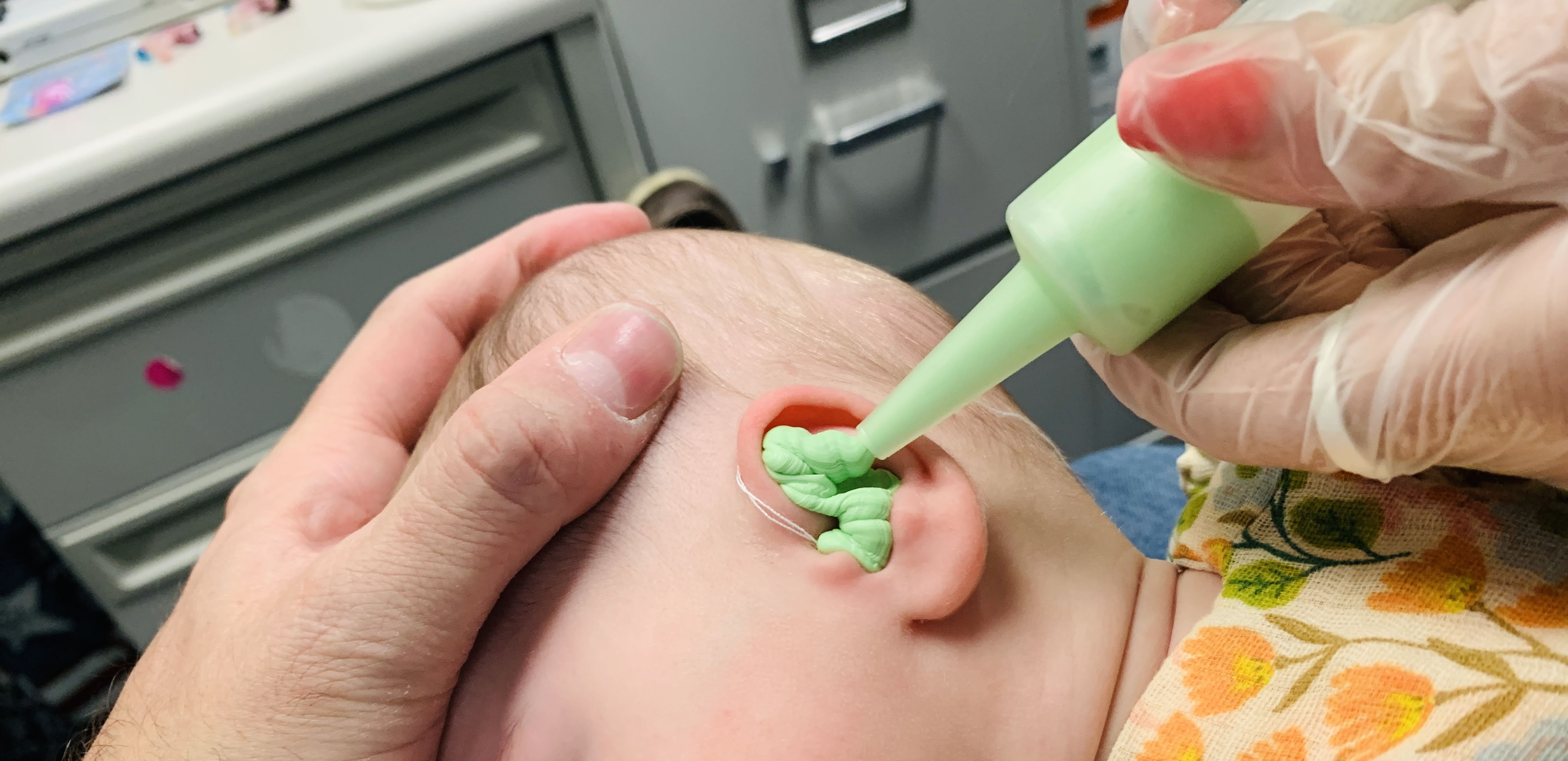
Basically, what happens (according to the layman observer) is:
- the doctor gently places a Styrofoam circle on a string into the baby's ear (to prevent the foam from going into the ear canal)
- the doctor slowly squirts foam into the baby's ear, like icing a cookie,
- the foam takes a minute to harden
- The doctor takes the foam out and, voila, a mold of your baby's cute little ear.
The audiologist also does a quick routine check of your child's ear canal before and after the procedure with an otoscope to check for obstructions, earwax, etc. If your baby or toddler is nervous about the otoscope, ask your audiologist to take a moment to show it to her and demonstrate its lights. A toy otoscope can also help your child get comfortable with it for future audiology visits.
Here are some tips and tricks we've learned to soar through the visit.
1. Build Enthusiasm Before the Appointment
Anticipating an event is 90% of it!
We try to reframe it from "we have to get molds taken" to "we get to have molds taken."
The morning of the appointment, explain what's going to happen. We say something like: "We're going to see a doctor friend today! Dr. ___ wants to see you! She's going to put something in your ears!"
Even if the baby can't understand the words, she gleans that something special is happening.
(And, really, making ear molds is cool. If you showed it to a bunch of third graders, they'd sign up!)
As your baby gets older, some audiology-themed pretend play with a toy doctor kit can make the appointment feel familiar and build positive associations.
2. Stay Calm and Keep It Positive
The easiest way to keep the baby calm is to keep ourselves calm. And there's no reason to worry!
The doctors have assured us that it might feel a little funny, but it doesn't hurt. And, it's over quickly.
We do sometimes discuss the "heavy" stuff with the audiologist at these appointments. But, we try to balance it with happy things.
Color options are also a great way to turn a heavier conversation back to something fun. Did you know ear molds come in colors, sparkles, and designs?
3. Help Baby Get Acclimated to the Room
Doctor's offices are interesting places to babies! While you chat with the doctor, let the baby look around.
That makes it less likely he'll whip his head around during the actual mold taking.
4. Bring a Distraction—Toys, Books, Snacks
To get a good mold, baby should be still until the foam hardens, which takes a couple minutes. Using a few interesting toys and books helps.
We've had the best luck with small fabric or board books and a tiny stuffed animal.
Looking for ideas? Touch and Feel Farm and Tweet! Tweet! were a couple of our favorite board books for babies.
5. Celebrate After
You did it! Hooray!
Pause outside the doctor's office to take a moment with your baby. We use this moment to praise her bravery and friendliness, and talk about how funny and interesting it was.
And when the molds come in, we hope you love them!
Celebration builds positive associations. That's helpful for the (many) future appointments. Looking for more ways to build positive associations for your child's audiology appointments as he or she gets older? Check out our article on audiology pretend play!
For what comes next, we have an article about our experience choosing Baby's hearing aid colors and a guide on what to expect when Baby gets his or her hearing aids.


